If you’re looking for a clear, chef-tested way to build your own recipe costing spreadsheet from scratch, this guide will walk you through the exact process kitchen professionals rely on every day. After years of helping small restaurants, caterers, and private chefs tighten their margins, I’ve learned that the most effective costing sheets aren’t complicated—they’re practical, accurate, and built to mirror real kitchen workflows.
In this tutorial, I’ll show you how to create a recipe costing system in Google Sheets or Excel using the same methods chefs use when portioning proteins, accounting for yield loss, updating fluctuating ingredient prices, and calculating plate costs in fast-paced environments. Instead of generic formulas, you’ll get insights drawn from actual back-of-house operations—like how to track sub-recipes, handle price fluctuations, factor in waste, and prevent margin creep.
By the end, you won’t just have a spreadsheet—you’ll have a tool designed the way a working chef would build it: efficient, accurate, and ready to update the moment ingredient costs change. Let’s build a costing sheet that truly supports the way you cook, price, and run your kitchen.
Quick Answers
food recipe costing template
A food recipe costing template is a simple spreadsheet chefs use to calculate the true cost of a dish. It tracks ingredient prices, yields, and portions so you can see exactly what each plate costs to make.
Key points:
- Shows cost per ingredient and cost per serving.
- Helps control waste and maintain profit margins.
- Works best when updated regularly with current vendor prices.
Top Takeaways
- Accurate recipe costing is essential for controlling food costs and protecting margins.
- Custom-built spreadsheets match real kitchen workflows better than generic templates.
- Rising food/labor costs and national waste data show why precise costing matters.
- Ingredient master lists and cost-per-serving formulas create consistent pricing.
- Regular updates and scalable tools keep your system reliable as your operation grows.
Why Building a Recipe Costing Spreadsheet From Scratch Matters
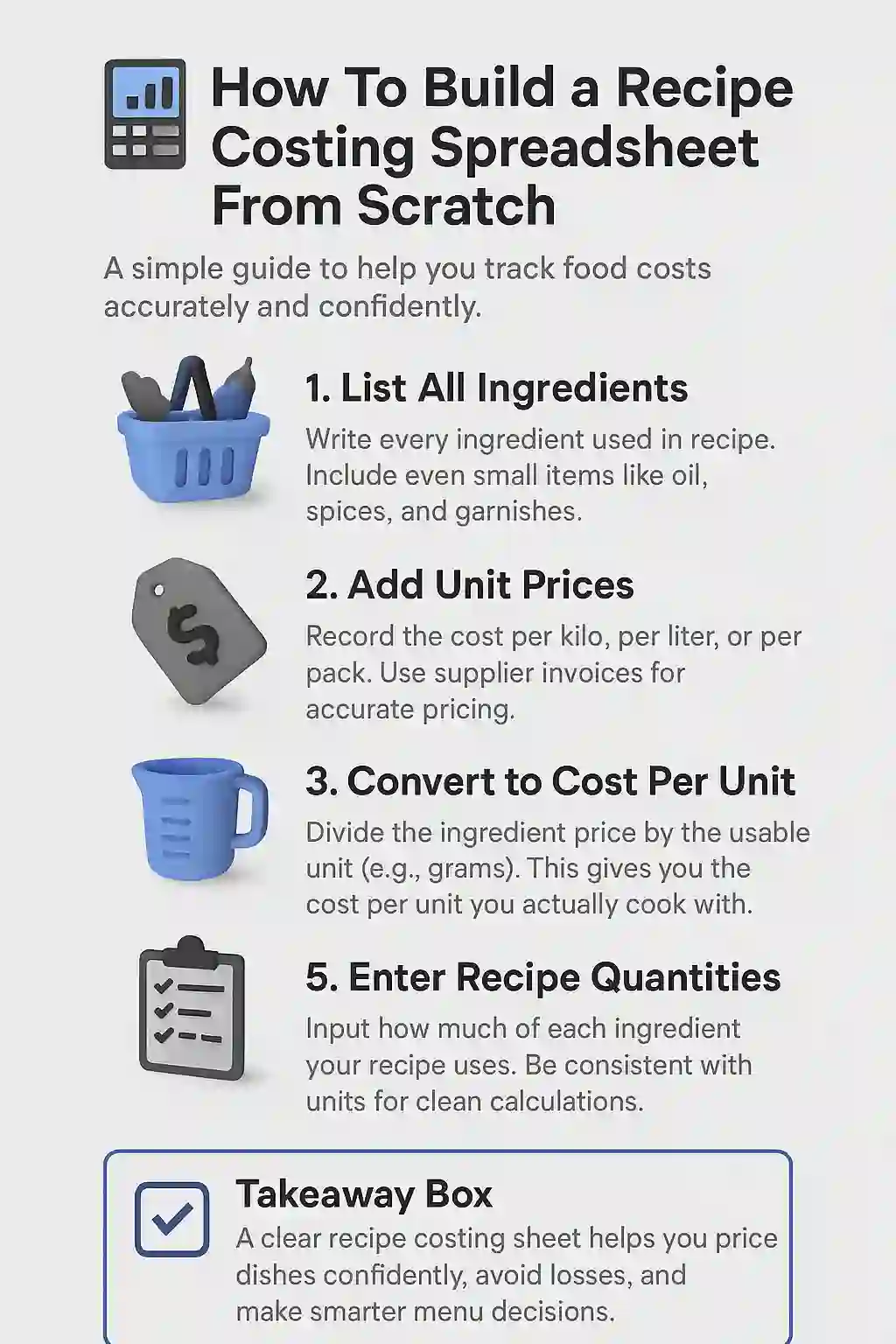
A recipe costing spreadsheet is one of the most essential tools for anyone responsible for pricing dishes. To build an effective one, start by listing all ingredients in a dedicated sheet along with unit costs, purchase sizes, and cost per gram or ounce. This gives you a master ingredient database that automatically feeds into your recipe calculations.
Next, create a recipe tab where you enter each ingredient, the quantity used, and the cost per unit. Using simple formulas—such as dividing the package cost by the number of units—you can calculate exact cost per ingredient and total recipe cost. If you’re using Google Sheets or Excel, functions like VLOOKUP, XLOOKUP, or INDEX/MATCH allow you to pull cost data directly from your ingredient list, ensuring every recipe stays accurate even when prices change.
From here, add portions or serving sizes to determine cost per serving. If you operate a food business, include optional fields for labor, overhead, and desired profit margin so the spreadsheet can automatically calculate ideal menu pricing.
By building your recipe costing spreadsheet step-by-step, you gain a deeper understanding of your food costs, prevent profit loss, and maintain consistency in your dishes. Whether you're scaling recipes, updating prices, or designing a new menu, this simple spreadsheet becomes a reliable tool to keep your kitchen profitable and organized, working seamlessly alongside a kitchen brigade system that depends on structure and clarity to support smooth operations.
“A well-built recipe costing spreadsheet isn’t just a pricing tool—it’s a reflection of how you run your kitchen. The most accurate sheets come from cooks and chefs who’ve learned, through years of trial, waste, and tight margins, exactly which numbers matter. When you build it yourself, you’re creating a system that speaks your language, matches your workflow, and protects your profit plate by plate, the same precision you’d apply when preparing something as delicate as skate fish.”
Top Chef-Approved Tools & Guides for Recipe Costing
1. Plug-and-Play Costing Templates from SpreadsheetPoint
URL: https://spreadsheetpoint.com/templates/recipe-cost-template-google-sheets/
SpreadsheetPoint offers solid starting templates for ingredient lists, yields, and cost-per-portion. Ideal for chefs who want a functional costing layout without building one from scratch.
SpreadsheetPoint offers solid starting templates for ingredient lists, yields, and cost-per-portion. Ideal for chefs who want a functional costing layout without building one from scratch.
2. Beginner-Friendly Google Sheets Templates & Walkthrough from SoftwareAccountant
URL: https://softwareaccountant.com/recipe-costing-template-google-sheets/
This guide pairs free templates with a clear, step-by-step tutorial so you can understand the entire costing structure. Perfect for small kitchens or home-based operations that need an easy learning curve.
This guide pairs free templates with a clear, step-by-step tutorial so you can understand the entire costing structure. Perfect for small kitchens or home-based operations that need an easy learning curve.
3. Excel Recipe Cost Calculator by Spreadsheet123 – Metric & Imperial Flexibility
URL: https://www.spreadsheet123.com/calculators/recipe-cost-calculator.html
Spreadsheet123’s Excel tool handles both metric and imperial units, making it useful for kitchens that buy in bulk or switch between unit systems. Reliable for calculating margins and controlling portions.
Spreadsheet123’s Excel tool handles both metric and imperial units, making it useful for kitchens that buy in bulk or switch between unit systems. Reliable for calculating margins and controlling portions.
4. Professional Costing Methodology from Chef-Focused Plate Cost Guides
URL: https://www.chefs-resources.com/kitchen-forms/recipe-template/plate-cost-how-to-calculate-recipe-cost/
This resource teaches the foundations of true recipe costing: yield tests, trim loss, hidden factors, and cost-per-portion logic used in commercial kitchens. Essential for anyone serious about accurate numbers.
This resource teaches the foundations of true recipe costing: yield tests, trim loss, hidden factors, and cost-per-portion logic used in commercial kitchens. Essential for anyone serious about accurate numbers.
5. Step-by-Step Worked Recipe Costing Example (Restroworks-Style Guides)
URL: https://www.restroworks.com/blog/recipe-costing-example/
A full costing example shows you each step in action—from ingredient breakdown to yield adjustments—so you can check your own spreadsheet against a real-world method.
A full costing example shows you each step in action—from ingredient breakdown to yield adjustments—so you can check your own spreadsheet against a real-world method.
6. Yield Testing & Sub-Recipe Costing Insights from Chef-Centric Resources
URL: https://www.getmeez.com/blog/a-chefs-guide-to-accurate-recipe-costing
Meez offers chef-driven insights for costing sauces, stocks, and batch preparations, plus how to factor EP vs AP weights. Excellent for building a spreadsheet that reflects actual kitchen operations.
Meez offers chef-driven insights for costing sauces, stocks, and batch preparations, plus how to factor EP vs AP weights. Excellent for building a spreadsheet that reflects actual kitchen operations.
7. Growth-Ready Advice on When to Move Beyond Spreadsheets
URL: https://home.binwise.com/blog/recipe-costing
BinWise helps you understand when a simple spreadsheet isn't enough—especially when scaling menus, tracking inventory, or managing multiple outlets. A helpful reference for future growth planning.
These chef-approved tools and guides give you the structure and accuracy needed to master recipe costing, and intensive agriculture examples highlight how carefully managed systems and precise inputs can create consistent, predictable results in any operation.
BinWise helps you understand when a simple spreadsheet isn't enough—especially when scaling menus, tracking inventory, or managing multiple outlets. A helpful reference for future growth planning.
Supporting Statistics: Key Numbers Every Kitchen Should Know
• Up to 40% of the U.S. food supply is wasted.
According to the USDA, 30–40% of all food produced in the U.S. goes to waste.
That’s more than $161 billion lost.
Kitchens experience this daily through spoilage, trimming, and over-prep.
• 1.2 pounds of food lost per person each day at retail.
The USDA Economic Research Service reports ongoing loss at the retail level.
This mirrors common kitchen patterns—small scraps and unused ingredients that add up fast.
These losses directly impact plate cost and menu profitability.
• Food and labor costs have risen about 35% since 2019.
The National Restaurant Association notes significant increases in core restaurant expenses.
Operators now deal with thinner margins and higher risk.
Accurate recipe costing is essential to stay profitable in this climate.
According to the USDA, 30–40% of all food produced in the U.S. goes to waste.
That’s more than $161 billion lost.
Kitchens experience this daily through spoilage, trimming, and over-prep.
The USDA Economic Research Service reports ongoing loss at the retail level.
This mirrors common kitchen patterns—small scraps and unused ingredients that add up fast.
These losses directly impact plate cost and menu profitability.
The National Restaurant Association notes significant increases in core restaurant expenses.
Operators now deal with thinner margins and higher risk.
Accurate recipe costing is essential to stay profitable in this climate.
Final Thought & Opinion
A well-built recipe costing spreadsheet isn’t just paperwork—it’s one of the most valuable tools a kitchen can have. After years working alongside chefs and operators, one lesson stands out: the kitchens that thrive are the ones that measure, not guess.
Why It Matters
Food and labor costs keep rising.
Waste adds up faster than most people realize.
A costing sheet protects your margins and your menu.
Food and labor costs keep rising.
Waste adds up faster than most people realize.
A costing sheet protects your margins and your menu.
What Real Kitchens Know
Trim loss, spoilage, and portion inconsistencies directly impact profit.
Accurate costing prevents surprises and supports consistent pricing.
Simple, chef-built sheets work better than overly complex templates.
Trim loss, spoilage, and portion inconsistencies directly impact profit.
Accurate costing prevents surprises and supports consistent pricing.
Simple, chef-built sheets work better than overly complex templates.
My Perspective
The best costing sheets are shaped by real workflows—not theory.
Building your own gives you control over yields, waste, and true costs.
Understanding your numbers becomes a competitive advantage.
The best costing sheets are shaped by real workflows—not theory.
Building your own gives you control over yields, waste, and true costs.
Understanding your numbers becomes a competitive advantage.
The Bottom Line
A recipe costing spreadsheet should be treated like any essential kitchen tool. When designed with intention and used consistently, it strengthens profitability, improves consistency, and brings confidence to every plate you serve.
Next Steps
Follow these quick, actionable steps to start building and using your recipe costing system.
Download or create your costing template.
Use Google Sheets or Excel. Start simple.
Set up your ingredient master list.
Include purchase unit, unit cost, and cost per gram/ounce.
Build your first recipe sheet.
Add ingredients, quantities, and formulas. Choose a familiar dish for accuracy.
Add yield and waste adjustments.
Factor trim loss, cooked weight, and prep waste.
Calculate cost per serving.
Include serving size, overhead, and desired margin.
Compare across multiple recipes.
Spot high-cost items and identify low-margin dishes.
Keep everything updated.
Refresh ingredient prices regularly.
Upgrade when you grow.
Move to costing software when managing more recipes or locations.
These steps help you build a recipe costing system that keeps your pricing accurate and your kitchen organized, in the same way the benefits of sustainable agriculture rely on consistent monitoring and smart resource management to maintain long-term stability and efficiency.
Download or create your costing template.
Use Google Sheets or Excel. Start simple.
Set up your ingredient master list.
Include purchase unit, unit cost, and cost per gram/ounce.
Build your first recipe sheet.
Add ingredients, quantities, and formulas. Choose a familiar dish for accuracy.
Add yield and waste adjustments.
Factor trim loss, cooked weight, and prep waste.
Calculate cost per serving.
Include serving size, overhead, and desired margin.
Compare across multiple recipes.
Spot high-cost items and identify low-margin dishes.
Keep everything updated.
Refresh ingredient prices regularly.
Upgrade when you grow.
Move to costing software when managing more recipes or locations.
FAQ on Food Recipe Costing Template
Q: What is a food recipe costing template?
A:
A spreadsheet that tracks ingredient costs, yields, and portions.
Works like a financial prep list for accurate dish pricing.
Q: Why is a costing template important?
A:
Small waste adds up quickly.
Helps manage rising prices and protects margins.
Keeps portioning and pricing consistent.
Q: What should a good costing template include?
A:
Ingredients, purchase units, unit cost, yield %, portion cost.
Optional: labor, overhead, sub-recipes for more accuracy.
Q: Can Google Sheets or Excel handle recipe costing?
A:
Yes. Both support formulas, easy updates, and custom layouts.
Ideal for busy kitchens needing quick adjustments.
Q: How often should I update my costing sheet?
A:
Update whenever prices change.
Monthly is typical; weekly for high-volume kitchens.
A:
A spreadsheet that tracks ingredient costs, yields, and portions.
Works like a financial prep list for accurate dish pricing.
A:
Small waste adds up quickly.
Helps manage rising prices and protects margins.
Keeps portioning and pricing consistent.
A:
Ingredients, purchase units, unit cost, yield %, portion cost.
Optional: labor, overhead, sub-recipes for more accuracy.
A:
Yes. Both support formulas, easy updates, and custom layouts.
Ideal for busy kitchens needing quick adjustments.
A:
Update whenever prices change.
Monthly is typical; weekly for high-volume kitchens.